Flag Football: The Surge in Youth Participation Amidst New CTE Data
Recent studies linking tackle football to brain disease have shifted family sports choices, driving a 14% increase in youth flag football participation from 2019 to 2024.
By Riya Zhao ·
Parents of young athletes are increasingly steering their children toward flag football as new medical data clarifies the long-term risks of head impacts in tackle sports.
A study published in April 2026 examined the brains of former NFL players who died between 2016 and 2021. Researchers found that 315 of the 338 brains studied showed signs of chronic traumatic encephalopathy, or CTE. That represents at least one in four deceased players.
A follow-up study released on Wednesday provided a broader estimate for the period between 2008 and 2023. The team analyzed 396 donated brains along with national death records for 1,966 other deceased former NFL players. They concluded that an estimated three out of four players in that group most likely had CTE. This is the highest prevalence estimate to date.
The research team included Dr. Daniel Daneshvar, Robert Stern, and Chris Nowinski. Stern co-founded the CTE Center at Boston University nearly 20 years ago. Nowinski serves as CEO of the Concussion and CTE Foundation. Both experts noted that CTE is a progressive brain disease caused by repeated head hits. The condition involves the buildup of an abnormal protein called tau. It can only be diagnosed with certainty after death.
Sandeep Basran, an assistant coach in the Chicago area, has kept his nine-year-old son in the i9 Sports flag football league for four years. The boy has suffered only a minor leg injury during that time. Basran cites the risk of minor, repetitive hits as his primary concern with tackle football. He believes these small impacts accumulate over time to affect the brain.
Basran also considers his son’s other athletic interests. The boy plays basketball, tennis, and golf. Basran worries that a serious football injury could jeopardize his ability to participate in those sports. His five-year-old daughter also plays flag football. He expects his son to continue playing the non-contact version of the game because he enjoys the sport and it protects his other seasonal activities.
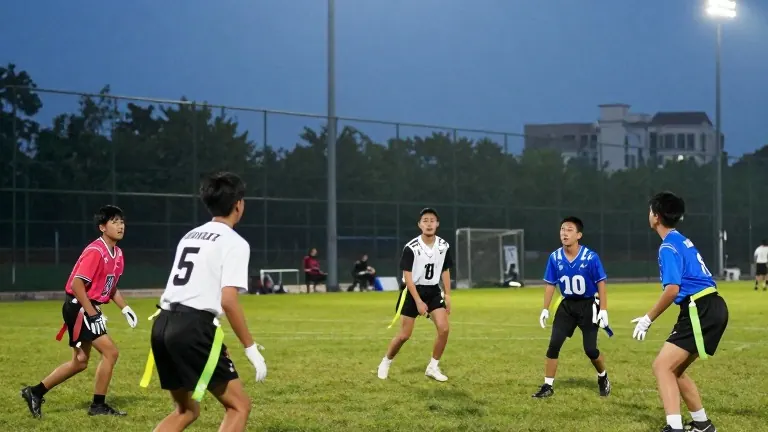
Flag football is distinct from tackle football in several ways. It features fewer players on the field at any given time. Teams wear less protective equipment. The pace of play is faster. There is no blocking or tackling. These factors reduce the frequency of high-impact collisions.
Tim Lewis, a coach in San Diego, notes rapid growth in girls’ flag football. He has coached boys for five years and is now coaching a girls’ team. He observes that the sport is exploding in popularity among female athletes. Torrey Pines High School recently hosted a girls’ flag football game where players in the crowd were announced at halftime. Lewis sees this as a sign of expanding community engagement.
Joe Becker, owner of i9 Sports in Chicago, highlights the growing institutional support for the sport. Flag football is now an official Illinois high school sport for girls. It will debut as an official Olympic event at the 2028 Los Angeles Games. Becker believes this visibility will drive further growth, particularly among girls who have fewer opportunities to play tackle football.
Data from the Aspen Institute’s State of Play report shows flag football was the only team sport tracked by the Sports and Fitness Industry Association that grew among children ages 6 to 17 between 2019 and 2024. Participation in flag football increased by 14% during that period. Tackle football participation declined by 7% in the same group. In 2017, flag football surpassed tackle as the most common form of the game for children ages 6 to 12. By 2024, 4% of kids in that age group played flag, compared to 2.7% for tackle. Among teenagers ages 13 to 17, tackle remains more popular, with 6.4% participation compared to 2.8% for flag.
The NFL reports that its NFL FLAG program serves more than 620,000 kids ages 4 to 17 across the country. An NFL spokesperson stated that the league continuously strives to make the game safer by implementing strategies to reduce concussions and head impacts.
Rashad Crawford, a former college football player at Indiana State, mentors young players in Chicago. He argues that the camaraderie and celebration elements of tackle football are present in flag. He has heard players in huddles plan specific touchdown celebrations. He predicts that the Olympic debut will accelerate the sport’s development and potentially lead to a professional league within the next five to six years.