Chile's Atacama Desert Sees Record Bloom After Historic Rains
El Niño-driven storms triggered the largest floral display in decades, drawing thousands of visitors and prompting a push for UNESCO World Heritage status.
By Elena Perry ·
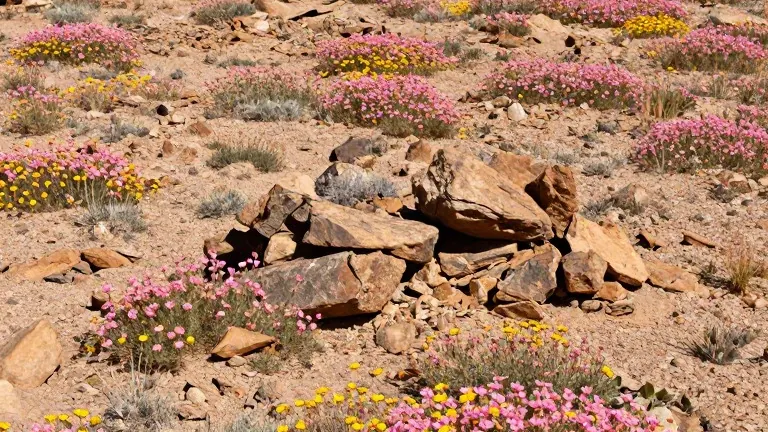
Heavy rainfall from the El Niño super cycle has transformed the Atacama Desert in Chile into a sprawling display of pink, yellow, lilac, and purple vegetation. The storm system delivered the heaviest precipitation to parts of the region since records began in the 1950s. This weather event caused flash floods in July and August, damaging dozens of homes and forcing hundreds of residents to evacuate their neighborhoods.
Despite the initial destruction, the rainwater penetrated deep into the parched ground, awakening millions of seeds, bulbs, and tubers that had remained dormant for decades. Scientists confirm that more than 200 species are currently in flower across the desert floor. Moisés Grimberg, administrator of Llanos de Challe National Park, described the event as a natural seed bank becoming a living archive. He noted that the biological window for these species to complete their life cycle lasts roughly two to three months.
The surge in visitors has outpaced historical norms. Llanos de Challe, a 113,000-acre national park along the arid coastline, typically welcomes about 10,000 visitors annually. Over the last few weeks, 15,000 tourists have visited the area. Chile's national tourism board projects that the region will host approximately 300,000 overnight trips during the two-month blooming period. Roads leading to the desert are now lined with vehicles from tourists eager to see the rare flora.
Among the most distinct attractions is the garra de león, a crimson flower with flame-like green leaves that grows along only a few miles of this specific coastline. This endemic species does not exist anywhere else in the world. The bloom has also supported a transient ecosystem, attracting insects, lizards, bats, and larger mammals such as the guanaco. Biologists from INIA, Chile's national seed bank, are actively collecting specimens to analyze in laboratories before the season ends.
Ana Sandoval, a biologist from INIA, said the desert is awakening, challenging the perception of the area as an empty, arid place. She explained that the plants have developed unique adaptations to harvest water, including leaves covered in fine hairs or thick waxy cuticles. The organization aims to preserve the genetic material of these plants to understand their survival mechanisms in extreme conditions.
Local officials are leveraging the event to advance conservation and economic goals. A national park dedicated to the bloom was established in June 2023 to protect a 141,000-acre area. Miguel Vargas, the governor of the Atacama region, has initiated the process of seeking UNESCO World Heritage recognition for the phenomenon. Vargas stated that this designation would diversify the regional economy, which is currently heavily reliant on mining, and place the Atacama region on the world stage. He hopes to secure the status within a couple of years, which would make it Chile's eighth World Heritage site.
The current bloom is projected to last until mid-November. As the flowers begin to fade, scientists face two open questions: whether this was the largest flowering event on record for the Atacama Desert, and if closer examination will reveal any previously unknown species among the millions of plants. The phenomenon is becoming more frequent as climate changes bring unseasonal rains to the driest nonpolar desert on Earth.