Ukraine's drone teams in Mali create new front against Russia
Fifteen Ukrainian specialists are reportedly training Tuareg rebels, a move that complicates Kyiv's diplomatic relations with three Sahel nations.
By Andrew Yang ·
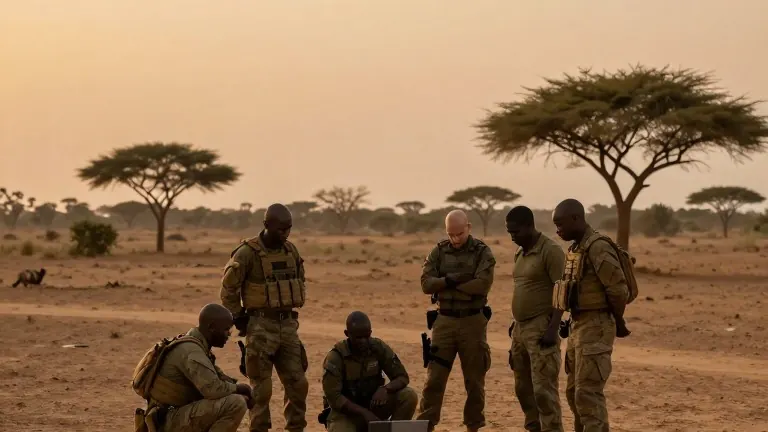
A CNN investigation published in September reports that approximately 15 Ukrainian drone specialists are operating in northern Mali. These experts are supporting Tuareg rebels who are fighting against the military government in Bamako and its Russian allies. The report suggests the conflict between Kyiv and Moscow has expanded beyond Europe into the African Sahel region.
The presence of these specialists would mark a direct Ukrainian engagement in a conflict where Russia has consolidated its military influence. Since 2020 and 2021, Mali has shifted away from Western partners and toward Moscow. The Russian Wagner Group, later reorganized as the Africa Corps in 2025, has served as a key security partner for the Malian military government.
Marta Oliynyk-D'omochko, a coordinator for African Studies at the National University of Kyiv-Mohyla Academy, argues that Ukraine has a strategic motive to weaken Russia's global reach. She told Deutsche Welle that if Russian military influence recedes, the associated economic opportunities for Moscow will also diminish. Russian historian Irina Filatova, a professor emeritus at the University of KwaZulu-Natal, finds the support plausible but notes she lacks independent evidence to confirm the specific deployment.
The Tuareg partners are the Azawad Liberation Front, a separatist group seeking autonomy in the north. The FLA cooperates with Jama'at Nusrat al-Islam wal Muslimeen, a jihadist group affiliated with al-Qaeda. This alliance creates a complex dynamic for Kyiv, as the FLA pursues self-determination while JNIM aims to impose strict Islamic rule. Oliynyk-D'omochko describes the arrangement as a situational alliance against a common enemy rather than a comprehensive partnership.
Suspicion of Ukrainian involvement dates back to July 2024, when a DW report detailed an ambush on Russian Wagner fighters near Tinzaouaten. At the time, Andriy Yusov, a spokesperson for Ukraine's military intelligence service, stated that Tuareg rebels had received necessary information for the attack. Kyiv denied direct involvement, though paramilitaries and Malian troops suffered heavy losses in the engagement.
Kyrylo Budanov, the former head of military intelligence and current chief of staff to President Volodymyr Zelenskyy, posted on X on September 7 that Ukrainian intelligence protects national interests worldwide. He referenced operations in "the burning desert sands and in the snows of icy Antarctica." While the post did not explicitly name Mali, it aligns with the timeline of the reported drone training activities.
Deutsche Welle contacted Ukraine's military intelligence service to verify personnel deployments and political approvals. The agency did not provide a specific response, with a spokesperson indicating that information might be released later. The lack of confirmation leaves the extent of Ukrainian involvement unclear despite the detailed claims in the CNN report.
Diplomatic friction has intensified as Mali, Niger, and Burkina Faso accuse Ukraine of supporting armed groups that threaten their territorial integrity. In September, Mali's Foreign Minister Abdoulaye Diop told the United Nations that Kyiv provides open support to terrorist groups to undermine Mali's integrity. Diop did not present evidence for these claims, but the three Sahel nations have severed diplomatic relations with Ukraine to deepen their ties with Russia.
Ulf Laessing, a former head of the Sahel program at the Konrad Adenauer Foundation, noted that the Africa Corps continues to use Syria and Libya as transit points for flights from Russia. He told Deutsche Welle that these routes support operations on the continent. Filatova argued that setbacks in Mali would tie up Russian resources and damage Moscow's reputation as a reliable security partner in the region.